Build log · Games
How I built Barkflip
A skate dog runner styled like a Y2K console title, with four dogs in four art mediums
1.Why I built it
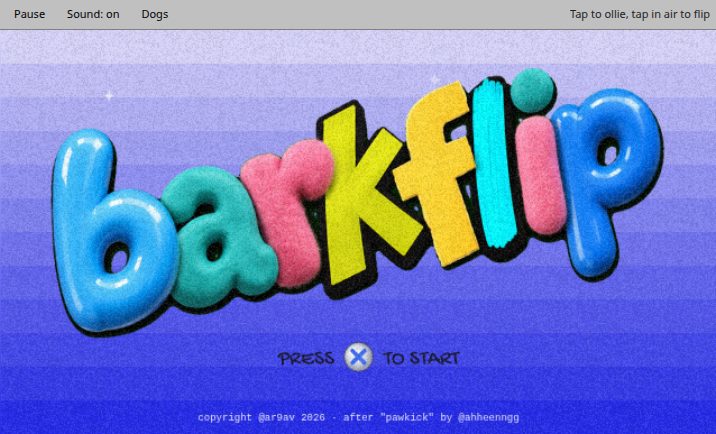
Barkflip is a skate dog runner dressed like a Y2K console game, after Heng's "Pawkick" teaser. The look is a banded periwinkle-to-cobalt sky, a logo where each letter is a different material, and a character select where each dog stands on a pixelated pink star under a light beam.
The part I wanted to try was mixing art mediums in one game. Each of the four dogs is drawn in a different medium (pencil sketch, vinyl toy, flat vector, claymation), and each has its own flow, power and control stats that change how it plays.
2.How it works
Stats that change the physics
Each dog is a small record with flow, power and control values from 1 to 10, and those numbers feed straight into the physics. Starting speed is 230 + flow * 6. Ollie velocity is 440 + power * 26. Flip duration is 0.46 - control * 0.018 seconds, and the landing tolerance for a half-finished flip is 0.05 + control * 0.014.
So Mochi (power 9) jumps highest, Noodle (control 9) flips fastest and forgives sloppy landings, and Scribbs (flow 8) gets a bigger combo multiplier, since the multiplier is combo length * (1 + flow * 0.04).
One tap, three tricks
A press on the ground or on a rail starts an ollie. A press in the air after 80 ms starts a flip, and consecutive flips in one jump step through a table: kickflip, heelflip, tre flip, hardflip, 360 hardflip, worth more each time. Holding the button in the first 0.28 s of a jump halves gravity, so a long press gives a floatier jump.
Grinds are detected when the dog is falling and its feet cross the top of a rail or bench. Rolling clean on the ground for 0.45 s banks the current combo; landing mid-flip bails, costs a life, drops the combo and cuts speed by 22%.
Spawning a street that ramps up
The level is generated just ahead of the camera. spawn() rolls a random number and places one pattern: a cone, a hydrant, a trash can, a pair of cones, a rail, a bench, or a kicker ramp that launches into an arc of bones and sometimes onto a high rail. A level value climbs from 0 to 1 over the first 9,000 px and shortens the gap between patterns, which scales with current speed so faster runs still get room to react.
Y2K textures generated at runtime
The sky bands, film grain and pedestal star are built once into offscreen canvases. The sky is 12 or 16 flat bands interpolated between two RGB colours. The grain is a 160 px tile of random black and white pixels at low alpha, drawn as a repeating pattern at a random offset each frame. The star is drawn on a 56 by 30 canvas and scaled up without smoothing to get chunky pixels.
The dogs, logo and props are images from scripts/generate-barkflip-sprites.mjs, which prompts gpt-image models with a separate medium description per dog and a 3 by 2 grid of skate park props, then keys out the background.
Looping noise for rolling and grinding
Rolling and grinding sounds are continuous, so instead of triggering one-shots the game keeps two looping noise sources running through bandpass filters and only moves their gain. Rolling gain rises with speed, the grind filter sits at 2600 Hz on rails and 900 Hz on benches, and setTargetAtTime smooths every change so nothing clicks. Scores, distance and the chosen dog are saved to Convex.
3.Try it
Tap or press to ollie, tap again in the air to flip, land on rails and benches to grind.