Build log · Games
How I built Feature Hunt
Four arcade stages about superposition, sparse autoencoders and causal feature tests
1.Why I built it
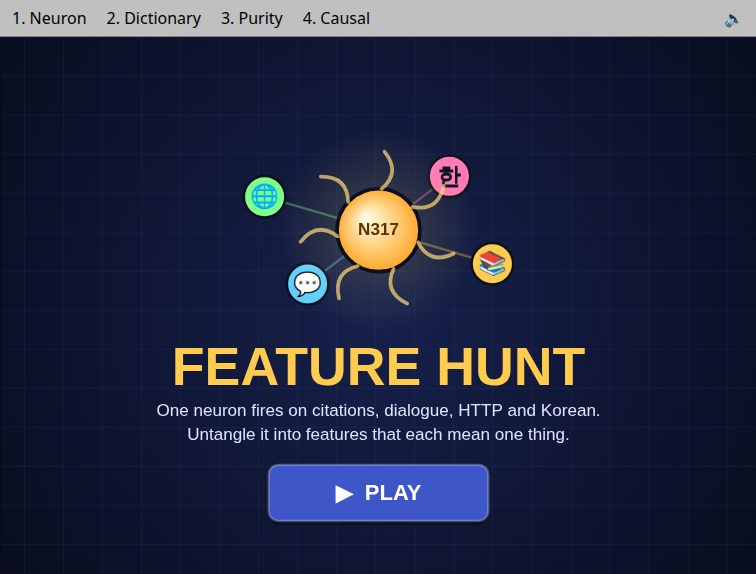
I wanted to explain the core ideas of mechanistic interpretability through play rather than diagrams: polysemantic neurons, superposition, sparse autoencoders, and testing whether a feature is really what it looks like. Each idea gets its own short stage, and each ends on a card that names the concept you just used.
Every stage is set up so the naive approach fails first. You can't tell what lit neuron 317 from the neuron alone, but you can once you read the direction of the activation. That gap is the lesson.
2.How it works
A two-dimensional toy model
The whole game lives in a 2D activation plane. Five concepts (citation, dialogue, HTTP, Korean and code) each have a direction, and a token's activation is a vector at that angle, with Gaussian jitter from a Box-Muller randn and a random magnitude. Neuron 317 is the x-axis and neuron 42 is the y-axis, so each neuron's reading is just the vector's projection on that axis.
Citation, dialogue, HTTP and Korean all project positively onto x, so neuron 317 fires for all four. That is polysemanticity in one picture. The dashed projection lines in stage 1 show why the single number is ambiguous while the angle is not.
You are the sparse autoencoder
In stage 2 the concept directions are shuffled around the circle, and tokens fly out of the origin along them. The player gets five beams, each a wedge with an angle and a half-width. That is more detectors than the two neurons (overcomplete), and the goal is for exactly one beam to fire per token (sparse). A token caught by two beams counts as a double and costs points.
The end card scores reconstruction (the share of tokens caught), purity (how much of each beam's catch is its main concept) and the one-beam-per-token rate, and puts them next to x ≈ D·f(x). Before scoring there is a short training phase where each beam glides toward the concept it caught most, with no two beams sharing one, as a picture of what gradient descent does to a dictionary.
Precision and recall with decoys
Stage 3 gives you a single citation beam, starting nine degrees off the true direction. The stream mixes real citations, including Korean-language ones like 김 외 (2024), with look-alikes such as "(back in 2024)" or HTTP/1.1 (RFC 2616) that sit in other concepts' directions. Every token is counted as a true positive, false positive, false negative or true negative.
Live gauges show precision and recall as you drag the beam and change its width. A wide beam catches everything and raises false alarms. A narrow one is pure but misses real citations. A clean feature needs both numbers high, in any language.
Causal tests by ablation and steering
Stage 4 shows three candidate features per round, in shuffled order. One is clean, one is polysemantic and also drives another concept, and one is a fake that only correlates with the target. Each has a switch for off (ablate), normal, or 3x (steer), and the model's output mix is recomputed from the switches.
A clean feature scales the target's output rate fully. A polysemantic one scales the target by 0.6 and another concept by 0.75. A fake barely moves the target when ablated and pushes an unrelated concept when steered. You have to run both tests to see the difference, and the round tracks which tests you have done before you pick.
3.Try it
Click to guess in stage 1, drag beams to aim them in stages 2 and 3 (wheel or arrows change width), and toggle ablate or steer switches in stage 4.